How to Write a NANDA‑I Nursing Care Plan:
A Step‑by‑Step Guide for Students
Published on • 7 min read
Staring at a blank care plan template with a deadline racing toward you? You’re not alone. Nursing students around the world rank care plans as one of the most challenging—and heavily graded—assignments. Professors expect clinical reasoning, perfect NANDA‑I diagnoses, measurable outcomes, and flawless APA 7th edition formatting.
This guide breaks down the process into clear, repeatable steps. You’ll learn how to collect assessment data, choose the right nursing diagnosis, write SMART goals, select evidence‑based interventions, and format everything correctly. By the end, you’ll have a blueprint you can apply to any case—and if you’re still stuck, we’ll show you where to get expert help.
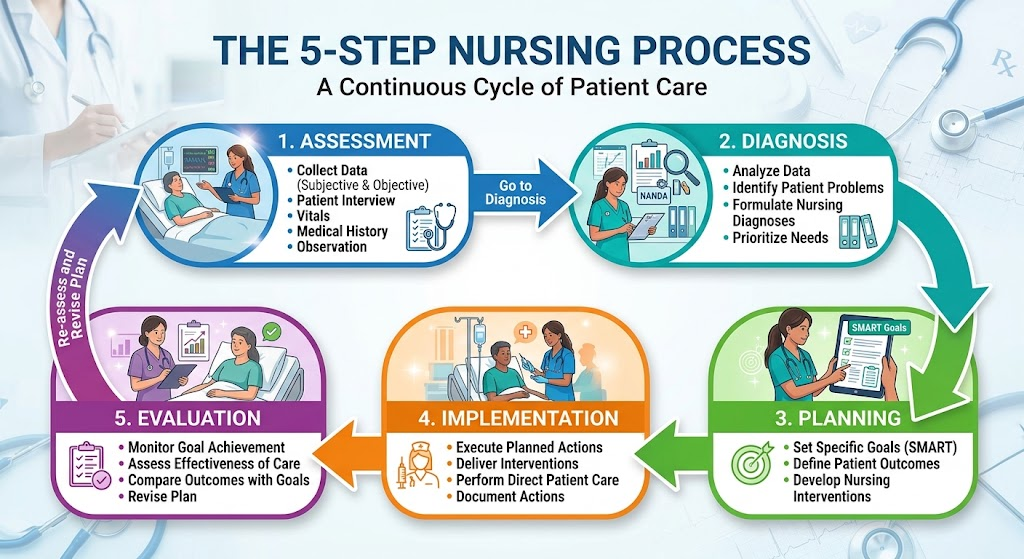
1. The 5‑Step Nursing Process (Quick Refresher)
Every care plan follows the same clinical decision‑making framework:
- Assessment – Gather subjective (what the patient says) and objective (what you observe/measure) data.
- Diagnosis – Identify the patient’s problem using a NANDA‑I approved nursing diagnosis.
- Planning – Set specific, measurable goals (outcomes) the patient should achieve.
- Implementation – Choose evidence‑based nursing interventions that will help meet those goals.
- Evaluation – Document whether the outcomes were met, partially met, or not met, and adjust accordingly.
2. Choosing the Right NANDA‑I Diagnosis
This step trips up many students. Don’t just pick a diagnosis that sounds familiar—map the patient’s actual assessment data to the definition and defining characteristics of a NANDA‑I label.
Here’s a quick reference table for common student cases:
| Assessment Clues | Possible NANDA‑I Diagnosis | Related To (R/T) Example |
|---|---|---|
| Pain reported 7/10, grimacing, guarding incision site | Acute Pain | Surgical incision |
| Crackles in lung bases, SpO₂ 91%, thick sputum | Impaired Gas Exchange | Alveolar‑capillary membrane changes |
| Stage 2 pressure ulcer on sacrum, redness, serous drainage | Impaired Skin Integrity | Immobility and moisture |
Always write the diagnosis in the standard format: Problem (NANDA‑I label) related to (etiology) as evidenced by (signs/symptoms). For example: Impaired Gas Exchange related to alveolar‑capillary membrane changes as evidenced by crackles, SpO₂ 91%, and thick sputum.
If you're struggling to map your patient's specific data to the correct NANDA‑I label, our dedicated nursing specialists can match your case perfectly. Explore our Nursing & Health Case Studies services for expert, rubric-aligned support.
3. Writing SMART Outcomes That Impress
Your goals must be Specific, Measurable, Achievable, Relevant, and Time‑bound. Avoid vague language like “patient will feel better.” Instead, write something like:
Good example:
“Patient will maintain SpO₂ ≥ 95% on room air within 48 hours after initiation of prescribed respiratory interventions.”
Weak example (avoid):
“Patient’s breathing will improve.”
4. Selecting Evidence‑Based Interventions
For each diagnosis, pick 3–5 interventions that are backed by credible sources (Cochrane, PubMed, nursing journals, or your course textbook). Every intervention must include a rationale — a short sentence explaining why you’re doing it, with an APA in‑text citation.
Example for Impaired Gas Exchange:
-
Intervention: Elevate head of bed to 45 degrees and encourage deep breathing
exercises
every 2 hours.
Rationale: Semi‑Fowler’s position optimizes diaphragmatic expansion and lung compliance (Berman et al., 2020). -
Intervention: Administer supplemental oxygen at 2 L/min via nasal cannula as
prescribed.
Rationale: Low‑flow oxygen therapy improves arterial oxygenation in hypoxemic patients (Ackley & Ladwig, 2022).
5. Real Student Example – Pneumonia Care Plan Snippet
Here’s how it all comes together in a simplified, APA‑formatted care plan for a 72‑year‑old patient with community‑acquired pneumonia.
Nursing Diagnosis
Impaired Gas Exchange related to alveolar‑capillary membrane changes as evidenced by crackles in bilateral lung bases, SpO₂ 89% on room air, and purulent sputum.
Outcome
Patient will maintain SpO₂ ≥ 95% on 2 L O₂ nasal cannula within 48 hours, and exhibit clear breath sounds on auscultation by discharge.
Interventions & Rationales
- Elevate HOB to 45° and encourage incentive spirometry use every 1 hour while
awake.
Rationale: Semi‑Fowler’s position reduces pressure on the diaphragm and promotes lung expansion; incentive spirometry prevents atelectasis (Lewis et al., 2021). - Administer prescribed antibiotics (ceftriaxone 1 g IV) on schedule and monitor for
allergic
reaction.
Rationale: Timely antibiotic administration reduces bacterial load and improves clinical outcomes in pneumonia (Mandell et al., 2019). - Assess respiratory status every 4 hours, including rate, depth, breath sounds, and
SpO₂.
Rationale: Frequent monitoring allows early detection of deterioration and timely intervention (Perry et al., 2022).
Evaluation (After 48 Hours)
SpO₂ stable at 96% on 2 L O₂; lung sounds improved with diminished crackles bilaterally; patient reports less dyspnea. Outcome met. Continue plan.
6. Mistakes That Lose Marks (Avoid These)
- Using a medical diagnosis instead of a nursing diagnosis (e.g., “Pneumonia” is medical; “Impaired Gas Exchange” is nursing).
- Writing vague outcomes without a timeframe or measurable criteria.
- Copy‑pasting textbook interventions without tailoring them to the patient’s specific data.
- Forgetting APA 7th edition in‑text citations and a reference list.
- Skipping the “as evidenced by” part of the diagnostic statement.
Avoid these common pitfalls entirely by having a professional nurse writer review your work or build it from scratch. Our team specializes in exactly this—we handle the NANDA‑I diagnostics, SMART outcomes, and perfect APA formatting for you. Check out our Nursing Care Plan writing service to secure top grades without the stress.
Need Help With Your Nursing Care Plan?
If your deadline is tight or you’re unsure about your case, our nursing specialists can create a fully original, APA‑formatted care plan based on your exact rubric. Every order is checked with plagiarism‑detection software and delivered on time.
Order Your Care Plan on WhatsAppOr visit our Nursing & Health Case Studies page to learn more.
References (APA 7th Edition Sample)
- Ackley, B. J., & Ladwig, G. B. (2022). Nursing diagnosis handbook (13th ed.). Elsevier.
- Lewis, S. L., Bucher, L., Heitkemper, M. M., & Harding, M. M. (2021). Medical‑surgical nursing (11th ed.). Elsevier.
- Perry, A. G., Potter, P. A., & Ostendorf, W. R. (2022). Clinical nursing skills & techniques (10th ed.). Elsevier.
*This is a simplified example for educational purposes; always cite the specific sources required by your instructor.